Pantry notebook 007 · November 15, 2026
How to add freeze-dried vegetables to noodles
Protect the noodle method first. Prepare one labeled vegetable portion separately, then test a one-pot version only when the water, timing, cooking status, and sodium are documented.
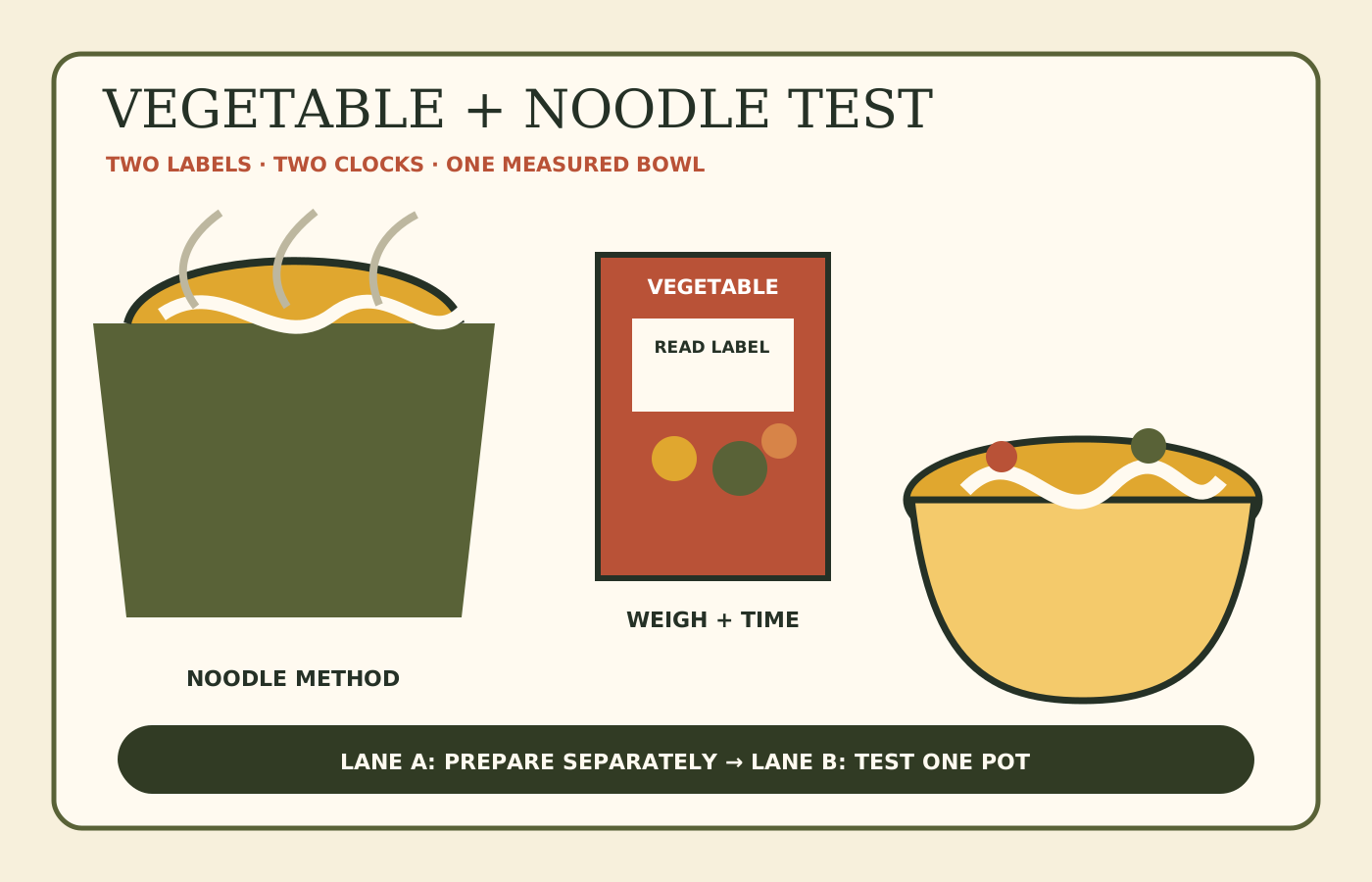
A noodle package may promise dinner in three minutes while a freeze-dried carrot dice needs longer to soften. Put both into the pot at once and one clock can finish before the other. The noodles go soft while the vegetables stay firm—or the broth disappears into an unmeasured second ingredient.
That mismatch is the reader question behind this guide. Public cooking and trail-meal discussions repeatedly ask how much extra water to add, whether vegetables can share the noodle soak, and why mixed pieces finish unevenly. Those discussions identify the friction; the package and current food-safety guidance supply the answer.
This is a two-lane method, not a universal recipe. Lane A prepares one vegetable portion separately while the noodles follow their own instructions. Lane B attempts a one-pot version only after Lane A records the vegetable's water, time, texture, and prepared yield. The result belongs to that product, cut, lot, noodle, pot, and method.
The 2026 FDA Food Code added § 3-501.10: commercially packaged dehydrated food with manufacturer rehydration information should be rehydrated according to those instructions. The Food Code is a model for retail and food service, but its label-first principle is useful at home. Follow the current package for water, cooking, allergens, storage, and whether the food is ready to eat.
Read two labels before opening either package
Copy the methods side by side. “Noodles” can mean instant fried ramen, air-dried ramen, rice noodles, glass noodles, wheat noodles, or a pasta shape that must be boiled and drained. “Freeze-dried vegetables” can mean ready-to-eat snack pieces, a single ingredient intended for rehydration, a seasoned blend, or part of a complete meal.
| Field | Noodle package | Vegetable package |
|---|---|---|
| Measured portion | Dry noodle block or gram amount | One labeled serving or weighed test amount |
| Water | Retained broth, absorption amount, or boil-and-drain volume | Exact amount, coverage direction, or no stated ratio |
| Heat | Boil, simmer, pour-over, microwave, or soak | Cold, warm, hot, boiling, simmering, or further cooking |
| Time | Cook plus covered rest | Soak, stir, simmer, or cooking time |
| Finish | Retain broth, drain, rinse, or sauce | Drain, retain liquid, cook further, or use directly |
| Nutrition basis | Serving size and sodium for noodles and seasoning | Serving size and sodium for vegetables or blend |
Confirm the statement of identity and ingredient list. A single-ingredient pea or carrot differs from a broth-seasoned vegetable blend. Salt, starch, dairy, soy, wheat, oil, sugar, yeast extract, or a carrier can change both water behavior and the finished meal. Do not assume a product is ready to eat because it is dry. Utah State University Extension emphasizes that freeze-drying does not kill bacteria; required cooking still matters.
Lane A: run a separate-soak control
The separate control protects the noodle texture and tells you what the vegetable does without competition from starch. It is especially useful for a new pouch, mixed cut sizes, pour-over noodles, or any product whose instructions do not expressly support direct addition.
- Choose one normal noodle portion. Record the noodle type, package method, pot or bowl, and whether its liquid is retained or drained.
- Weigh one vegetable portion. Record product, lot, cut, dry grams, seasoning, and visible fines. A gram weight is more repeatable than an irregular scoop.
- Prepare the vegetable exactly as labeled. Measure water, temperature, time, stir steps, and any required simmer or cooking.
- Prepare the noodles by their own package. Do not reduce their water because the vegetables are in a different vessel.
- Measure the vegetable result. Record prepared weight or volume, free liquid, core texture, and whether the label says to drain.
- Combine at the least disruptive stage. Fold a fully prepared vegetable into drained noodles or add it to finished broth. If the package requires further cooking, complete that requirement first.
- Score the bowl. Note noodle bite, vegetable center, broth volume, seasoning balance, distribution, and total yield.
Keep any vegetable soaking liquid only when the package permits it and its flavor suits the bowl. Do not treat cloudy or strongly flavored liquid as automatically useful. A separately prepared control can reveal bitterness, salt, fines, or a color load that would have been blamed on the noodles.
Lane B: test one pot with a written water budget
Attempt one pot only when the vegetable's instructions support direct cooking or can be completed within the noodle method. Keep the same noodle, portion, vessel, and heat method used for the control. Change one variable: the vegetable addition.
Brothy noodles are more forgiving of retained liquid than drained noodles, but a visible broth is not proof that every piece is prepared. Conversely, a boil-and-drain noodle method may provide abundant water yet too little time for dense vegetables. Water volume and contact time are separate variables.
- Write the hypothesis. Record vegetable grams, added water if any, and the exact addition time before heating.
- Set a texture deadline. The vegetable must satisfy its instructions without pushing the noodles past their intended finish.
- Give dense pieces a documented head start. Only do this when the vegetable label permits the heat method. Do not improvise around a required cook step.
- Add quick pieces later. Flakes, herbs, or small bell-pepper fragments may need less time than corn, peas, carrot dice, thick mushrooms, or stems.
- Keep seasoning separate until the water test is visible. A concentrated packet can hide whether the vegetable liquid changed flavor or volume.
- Measure the final bowl. Record remaining broth or drained yield, noodle texture, vegetable texture, and total preparation time.
If the noodles are soft and the vegetables remain firm, do not simply cook the same batch longer next time. Prepare the vegetables separately or give a supported head start. If broth is short, distinguish liquid absorbed by the vegetables from liquid lost to evaporation or starch. If both components are tender but the bowl is too dilute, adjust the documented liquid or portion—not every variable at once.
Choose the timing lane by product, not color
Prepare and fold in
The dependable first route for mixed vegetables, uncertain instructions, or drained noodles. It preserves both methods.
Vegetable head start
For dense pieces when the package supports the same hot-water or simmer method and their clock is longer than the noodle clock.
Shared start
Use only when labeled vegetable time and noodle time align and the combined water budget is documented.
Late finish
For fully prepared vegetables, quick flakes, or herbs that need brief warming rather than a full noodle cook.
Mixed pouches may need more than one lane. A fine onion fragment can disappear before a carrot center softens. Sort only if that is practical and does not conflict with the package; otherwise use the densest meaningful piece as the texture check and accept that a mixed cut has a range rather than one exact finish.
Pour-over noodles need special restraint
A covered cup loses heat after water is added. Adding a cold bowl, too much dry material, or a dense vegetable portion can lower temperature and change the noodle result. If the vegetable requires boiling or simmering, a pour-over cup does not replace that instruction. Prepare it separately with the required heat.
Add the sodium after aligning servings
Instant noodles, broth packets, bouillon, seasoned vegetables, sauces, and toppings can each contribute sodium. The FDA advises checking serving size and servings consumed; its general guide considers 5% Daily Value or less per serving low and 20% or more high. That is a comparison tool, not a reason to combine unlike serving bases.
Make a simple bowl ledger: sodium from the noodle serving actually used, plus the fraction of seasoning packet used, plus the vegetable serving, plus broth base and sauce. If one label describes dry food and another describes prepared food, align the amount eaten before adding. Never infer “low sodium” from a plain-looking vegetable pouch; read the Nutrition Facts and ingredients.
Noodle-bowl sodium check
Keep each labeled source visible
- Noodle serving and servings used
- Seasoning packet fraction used
- Vegetable serving and servings used
- Bouillon or broth concentrate
- Soy sauce, miso, chili sauce, or other finish
- Total based on the actual bowl amount
A printable two-lane noodle worksheet
Print this page and complete one card per product combination. The print stylesheet keeps the article and source record readable; this card gives the next bowl a direct starting point.
Vegetable + noodle test card
Product and method
- Noodle name/type/lot: __________________________
- Noodle portion, water, heat, and time: ___________
- Vegetable name/cut/lot/dry grams: ______________
- Vegetable water, heat, time, and cook status: _____
- Lane A prepared yield and texture: ______________
- Lane B addition time and added water: ___________
- Final noodle texture/broth or drained yield: ______
- Sodium sources and servings used: ______________
- Cook date, use date, and next adjustment: ________
Do not turn one kitchen card into a manufacturer yield, shelf-life promise, or universal ratio. It records one labeled product, lot, amount, vessel, and method.
After water, treat the bowl as prepared food
Dry packages may be shelf stable under their labeled conditions; prepared vegetable noodles are not. Divide a large batch into shallow containers and refrigerate within two hours, unless the package is more restrictive. USDA says small amounts of hot food may go directly into the refrigerator and large pots of soup should be divided into small portions and shallow containers.
When reheating leftovers, USDA advises reaching 165°F throughout and bringing sauces, soups, and gravies to a boil. Stir covered microwave portions and allow standing time so cold spots do not hide. Reheating cannot rescue food left at room temperature too long, because some toxins can persist after high heat.
Noodles continue absorbing liquid in storage. Record whether the bowl was broth-rich or drained, then add liquid deliberately when reheating. Quality may decline before the safety window ends, so make only the amount the household will actually use.
A purchasing note for this preview pantry
Freeze Dried Savory publishes education and unbranded pantry briefs. Checkout, prices, inventory, branded listings, availability, reseller claims, and supplier claims remain disabled until authorization and accurate commercial terms are documented. A useful vegetable listing should show the exact cut, ingredients, allergens, net weight, serving basis, preparation method, cooking status, storage directions, and manufacturer-stated yield.
Sources
Reviewed November 15, 2026. Product-specific manufacturer instructions remain controlling.
- U.S. Food and Drug Administration — Food Code 2026
- FDA — Summary of Changes in the 2026 Food Code
- FDA — Sodium in Your Diet
- Utah State University Extension — Can I Freeze-Dry That?
- USDA FSIS — Can You Put Hot Food in the Refrigerator?
- USDA FSIS — What Methods of Reheating Food Are Safe?
- Augason Farms — Water for Freeze-Dried Food